
GEO vs Traditional SEO: What’s Changing?
For years, the goal of search marketing was relatively straightforward: Get your website to rank on Google when potential customers search.
That goal still matters. But the way people discover information is changing.
Instead of only scrolling through a list of blue links, people can now ask complex questions and receive synthesized answers from AI-powered search experiences and answer engines.
That shift has introduced another concept into the search conversation: Generative Engine Optimization (GEO).
But does GEO replace traditional SEO? Not quite.
The bigger change is this: Search optimization is evolving from competing only for rankings to competing for visibility across both search results and AI-generated answers.
You need to understand the distinction because it is becoming increasingly important for your business, especially if you’re building long-term organic visibility.
A Look at Traditional SEO and GEO.
Let’s take a moment to explain SEO and GEO.
Search Engine Optimization (SEO) is the process of improving a website so that search engines can understand, crawl, index, and surface its content for relevant searches.
Generative Engine Optimization (GEO) is the practice of improving content and digital presence so that information is easier for AI-powered search and answer systems to understand, trust, retrieve, and potentially reference when generating responses.
GEO vs SEO: What’s Actually Different?
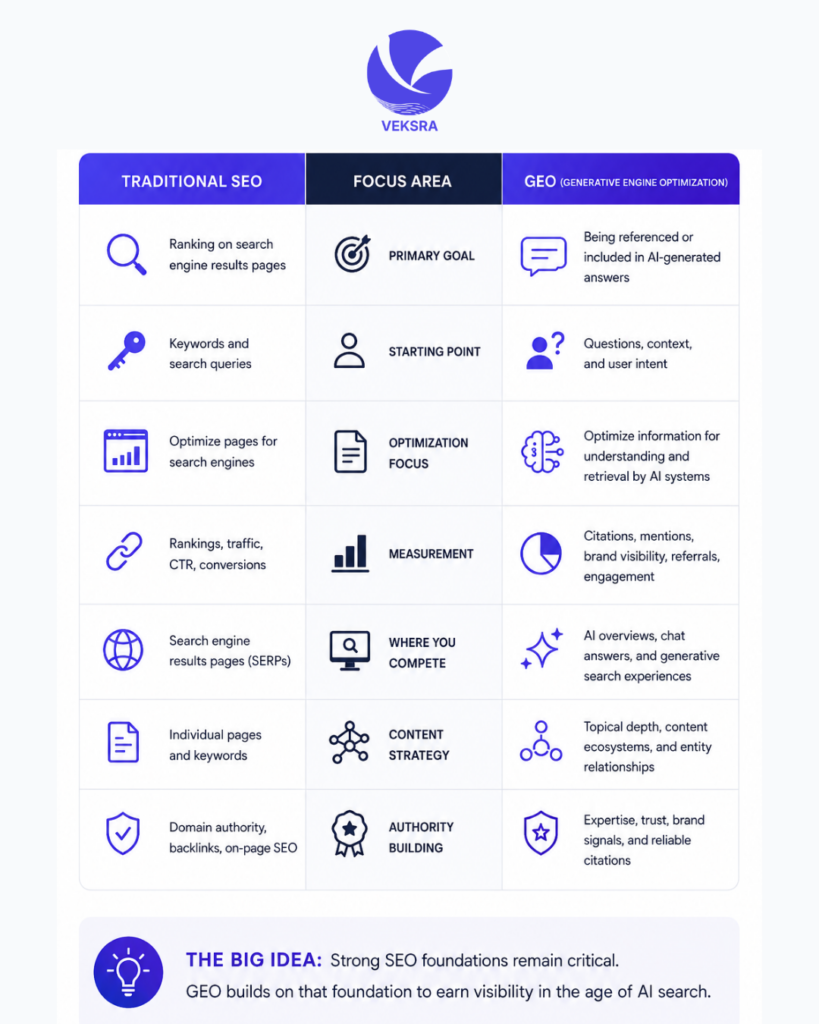
SEO and GEO overlap considerably, but you need to know that they emphasize different outcomes.
| Traditional SEO | GEO |
|---|---|
| Focuses heavily on search engine visibility | Focuses on visibility within generative and AI-driven searches |
| Competes for rankings and organic clicks | Competes for citations, references and inclusion in generated answers |
| Often begins with search queries and keywords | Places greater emphasis on questions, entities, context and relationships |
| Optimizes webpages for discovery and ranking | Optimizes information for understanding and retrieval |
| Measures rankings, traffic and conversions | May also consider AI mentions, citations and referral visibility |
| Targets search engine results pages | Extends discovery into AI answer environments |
You don’t need to treat these as two completely separate disciplines, because that would be a mistake. Much of what makes a website strong for traditional search can also create a better foundation for AI discovery.
What Is Not Changing In SEO?
This question is important because the arrival of AI search doesn’t suddenly make good SEO irrelevant.
Businesses still need websites that are:
- Crawlable – Search systems need access to your content.
- Understandable – Your site architecture and content need clear context.
- Useful – Content should genuinely answer the audience’s questions.
- Authoritative – Your claims should be supported by expertise, evidence, experience, and credible sources where appropriate.
- Well-structured – Headings, internal links, structured data, entities, and logical information architecture all help systems understand what your content is about.
What this means is: GEO isn’t permission to abandon SEO fundamentals. It makes strong fundamentals even more important.
What Is Changing In SEO?
So, several aspects of search optimization deserve more attention as AI-driven discovery grows.
- From Keywords to Context:
Keywords still matter. But optimizing a page around one exact phrase is insufficient. Search engines have become much better at understanding relationships between concepts. - From Individual Articles to Content Ecosystems:
This is where topical authority becomes increasingly valuable. Publishing one excellent article can help. Building an interconnected library around an important subject can be far more powerful. - From Ranking to Being Referenced:
Traditional SEO often asks: “Where are we ranking?”
GEO introduces another question: “When AI systems answer questions about our area of expertise, does our brand appear?”
That creates new forms of visibility. - Clear Answers Matter More:
AI systems often need to extract specific pieces of information from larger documents. That makes content structure important.
Compare: “In today’s rapidly evolving digital landscape, businesses seeking to maximize their online potential must consider numerous innovative methodologies…”
with: “Generative Engine Optimization (GEO) is the practice of improving content so AI-powered search and answer systems can better understand, retrieve, and potentially reference it.”
The second version gets to the point.
Good GEO content doesn’t mean robotic content. It means clear communication. - Brand Authority Becomes More Important:
If several websites make the same claim, why should a search or AI system trust yours?
This is where authority becomes important. You need to think beyond publishing content and toward building recognizable expertise.
That can include:- Original research
- Expert commentary
- Case studies
- First-hand experience
- Transparent authorship
- Strong About and author pages
- Consistent brand information
- Relevant mentions and links
- Reliable references and citations
The internet doesn’t need another rewritten definition of SEO.
It needs useful information that adds something.
- Search Intent Is Becoming More Conversational:
Traditional keyword research often produces phrases such as: “local SEO services”
But users interacting with AI can express much more complicated needs: “My business appears on Google Maps but isn’t generating calls. What should I check first?”
That creates opportunities for content addressing specific problems, situations, comparisons, and decisions.
Businesses should therefore research not only keywords but also:- Customer questions
- Pain points
- Objections
- Comparisons
- Follow-up questions
- Buying considerations
- Real-world scenarios
The future of content strategy is not simply a bigger keyword spreadsheet.
It is a deeper understanding of the customer.
- Zero-Click Discovery Changes How We Think About Success
Not every search journey ends with a website click.
You may get enough information directly from a search result or AI-generated response.
This can sound threatening to marketers.
But it also forces an important question: What are we actually optimizing for?
If the only goal is pageviews, fewer clicks are a problem.
If the goal is business growth, the picture becomes more nuanced.
Search visibility can contribute to:- Brand recognition
- Branded searches
- Trust
- Direct visits
- Leads
- Assisted conversions
- Mentions
- Revenue
Traffic still matters.
But businesses increasingly need to measure the business impact of visibility, not traffic in isolation.
Does GEO Replace SEO?
Your question now might be whether Geo replaces SEO. The answer is simple: No. At least, that’s not a useful way to think about it.
SEO remains the foundation.
A website with serious technical problems, weak content, unclear entities, poor architecture, and little authority isn’t suddenly going to succeed because someone added “GEO” to the strategy.
A better model is:
Strong SEO foundations ➡️ High-quality, authoritative content ➡️ Clear entities and topical relationships ➡️ Search + AI discoverability ➡️Qualified visibility ➡️ Business outcomes
The important thing to remember is that GEO extends search optimization into a changing discovery environment.
It doesn’t erase everything that came before it.
How Your Business Should Adapt
You don’t need to rebuild your entire SEO strategy. Just start by improving the fundamentals.
- Strengthen technical SEO: Make sure important content can be crawled, indexed, rendered, and understood correctly.
- Build topical depth: Stop publishing disconnected articles simply to target keywords. Create interconnected content ecosystems around subjects relevant to your business.
- Answer real customer questions: Use sales conversations, Search Console data, customer research, support questions, and keyword research to understand what people genuinely want to know.
- Make expertise visible: Show who created the content, why they are qualified to discuss the subject, and what evidence supports important claims.
- Structure information clearly: Use logical headings, concise definitions, internal links, descriptive anchor text, and appropriate structured data.
- Build your brand beyond your website: Authority doesn’t exist in isolation.
Relevant mentions, citations, partnerships, reviews, links, communities, and third-party coverage can strengthen your brand’s broader digital footprint. - Measure more than rankings:
Continue monitoring:- Organic rankings
- Search impressions
- Organic traffic
- Conversions
- Qualified leads
- Revenue
But begin paying attention to emerging signals such as AI referrals, brand mentions, citations, and how your brand appears across AI-powered discovery experiences.
SEO and GEO Should Work Together
Do not get confused by all of this. The debate shouldn’t really be SEO vs. GEO.
It should be: How do we build visibility wherever our customers search?
Today, that could mean Google. Tomorrow, the same customer might use an AI assistant, an AI-powered search experience, a social platform, or another discovery tool.
The channel may change. The underlying business objective doesn’t: You need to be present when the right customer is looking for what you know, solve, or sell.
That is the bigger opportunity.
Final Thoughts: Search Is Evolving, Not Disappearing
Every major change in search produces predictions that SEO is dead. As a matter of fact, I keep hearing this. Yet the fundamental need remains.
People have questions. Businesses have answers, products, services, and expertise. Something has to connect the two.
What is changing is how that connection happens.
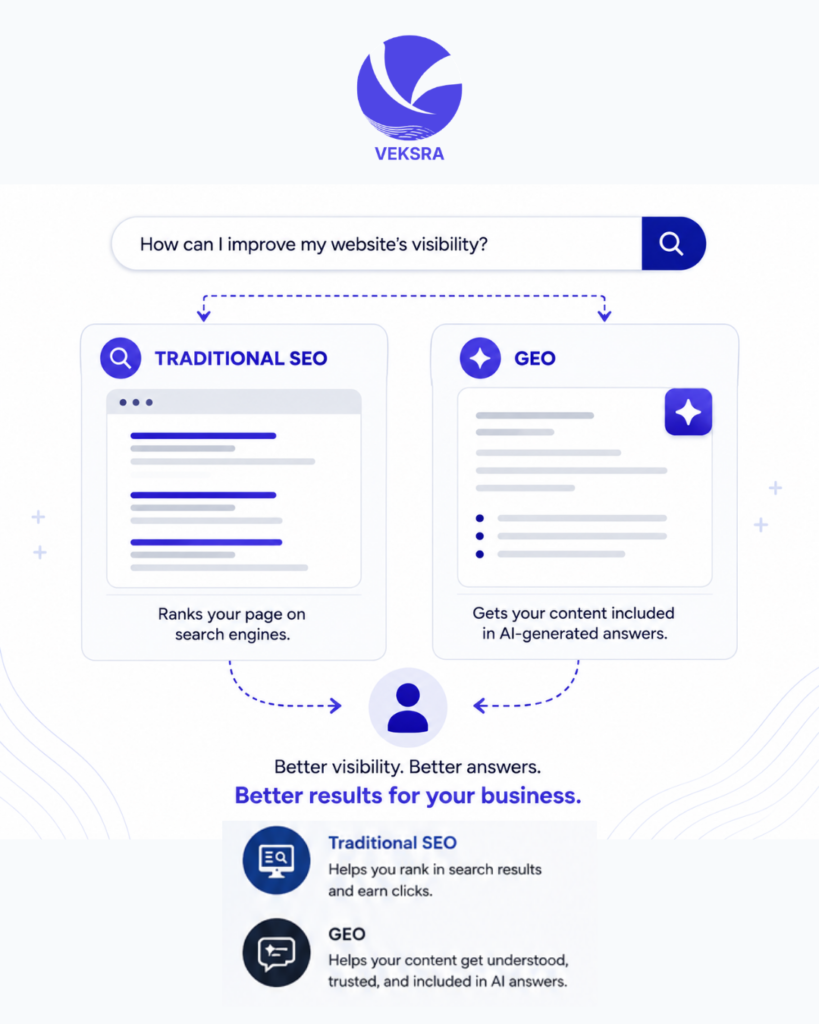
Traditional SEO helps businesses compete for visibility in search engines. GEO extends that thinking into generative discovery, where being understood, trusted, and referenced may become increasingly valuable.
The businesses best positioned for this shift won’t be the ones chasing every new acronym. They’ll be the ones building technically sound websites, genuinely useful content, recognizable expertise, strong topical ecosystems, and measurable customer value.
Because whether the answer appears as ten blue links or an AI-generated response, one principle remains:
Visibility only matters when it reaches the right people and creates the opportunity for action.